
TRIZ - The Ideal Final Result
Stating the Impossible
Ideal Final Result
Looking Backwards towards the Present
Inversion
Introduction
How “unreasonable” can we become?
In the previous Module on the Unreasonable Effectiveness of Available Resources we understood how to identify resources in everyday situations and to come to terms with our assumptions and functional fixedness. This is the first and most important step in the TRIZ Problem Solving Method.
Another important idea in TRIZ is that of the Ideal Final Result(IFR).
The Intellectual Position in stating the IFR
Here are two quotes:
“The reasonable man adapts himself to the world: the unreasonable one persists in trying to adapt the world to himself. Therefore all progress depends on the unreasonable man.” — George Bernard Shaw
And from Alice in Wonderland:
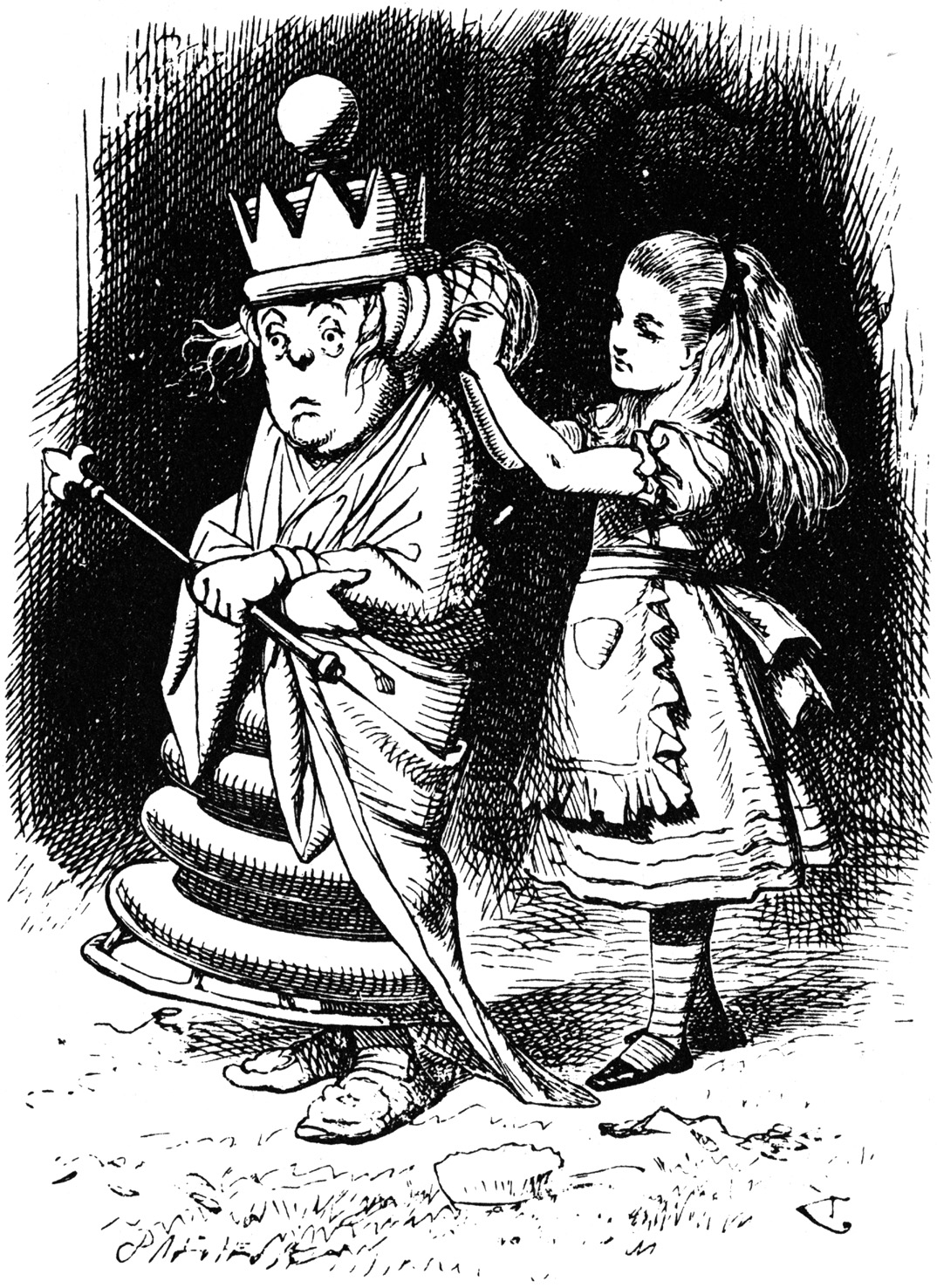
“How old are you?” said the queen.
“I’m seven and a half exactly.”
“You needn’t say “exactly” the queen remarked : “I can believe it without that. Now I’ll give you something to believe. I am just one hundred and one, five months and a day”
“I can’t believe that!” said Alice.
“Can’t you?” the Queen said in a pitying tone. “Try again: draw a long breath, and shut your eyes.”
Alice laughed. “There’s no use trying,” she said: “one can’t believe impossible things.”
“I daresay you haven’t had much practice,” said the Queen. “When I was your age, I always did it for half-an-hour a day. Why, sometimes I’ve believed as many as six impossible things before breakfast.”
So, how “unreasonable” and “impossible” can we become? Alice could not, but the Queen said she could contemplate, and believe, 6 impossible things before breakfast!
The Ideal Final Result
A basic principle of TRIZ is that systems evolve towards increased ideality, defined as:
\[ Ideality = Benefits / ( Harm + Costs) \] As we contemplate our Problem and attempt to solve it, our evolution is in the direction of:
- ⬆ Increasing benefits
- ⬇ Decreasing costs
- ⬇ Decreasing harm
The extreme result of this evolution is the Ideal Final Result. The Ideal Final Result (abbreviated IFR) is an implementation-free description of the Situation after the problem has been solved. The IFR allows us to invert the direction of the problem: to come backwards from Solution towards the Situation. In this sense, the IFR may seem to be ignoring Reality, but it forces to use a very strong Cognitive Tool/Mental Model: Inversion. Also see IP:13-The Other Way Around.. And naturally, Lawrence of Arabia and Inverting the Problem.
The goal of formulating the IFR is to eliminate rework (solve the right problem the first time!) by addressing the root cause of the problem or customer need. The IFR helps you reach breakthrough solutions by thinking about the solution, not the intervening problems. It focuses on customer needs or functions needed, not the current process or equipment.
Here then, is a “definition” for the IFR:
ImportantThe Ideal Final Result: A Definition
The Ideal Final Result describes the solution to a technical problem, independent of the mechanism or constraints of the original problem. The Solution occupies no space, has no weight, requires no labour, requires no maintenance.
The IFR has the following 4 characteristics:
- Eliminates the deficencies of the original system
- Preserves the advantages of the original system
- Does not make the system more complicated (uses free or available resources.)
- Does not introduce new disadvantages
The Ideal Final Result: Game #1
Look at the graph below: does it remind you of something you know very well?
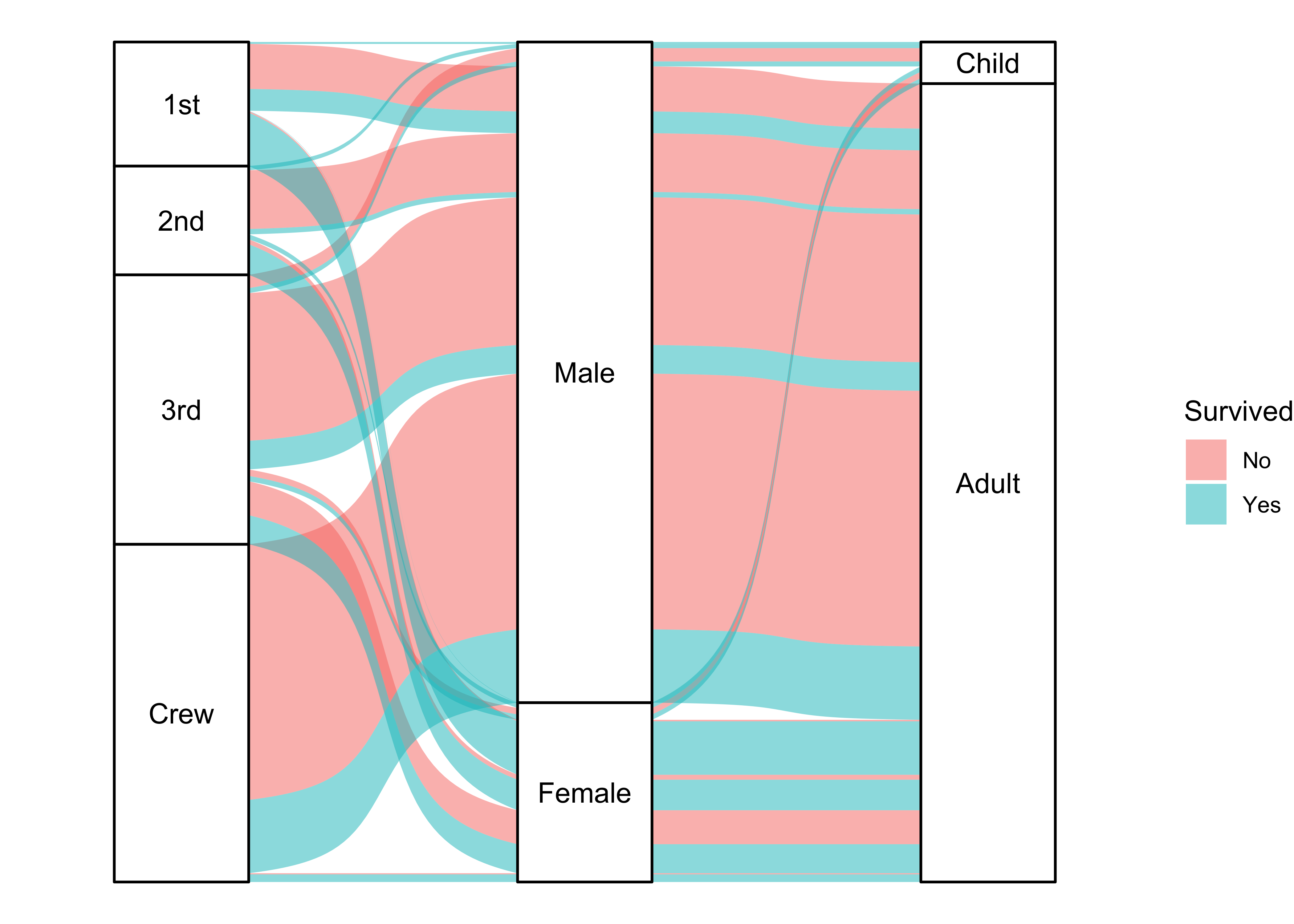
What does this graph represent? Let us pretend we are part of this graph and see where our Problem Formulating Skills take us!
What Resources do we have?
- People: Crew, Passengers
- Life Boats, with food and water for several days
- Life Jackets that float
- Furniture, Chairs, Sofas, Beds…
- Crockery
- Food and Drink, Groceries, Stores
- Safety Equipment, Ropes, Hammers, Axes…
- Clothes
- Engines, Fuel, Engine Propulsion
- Radio, Smoke Signals, Flares, Lights, Torches
- Sea Water
- Ice
- Titanic is tilting from the front
- The RMS Carpathia ( arrives in 4 hours )
Figuring out the Resources
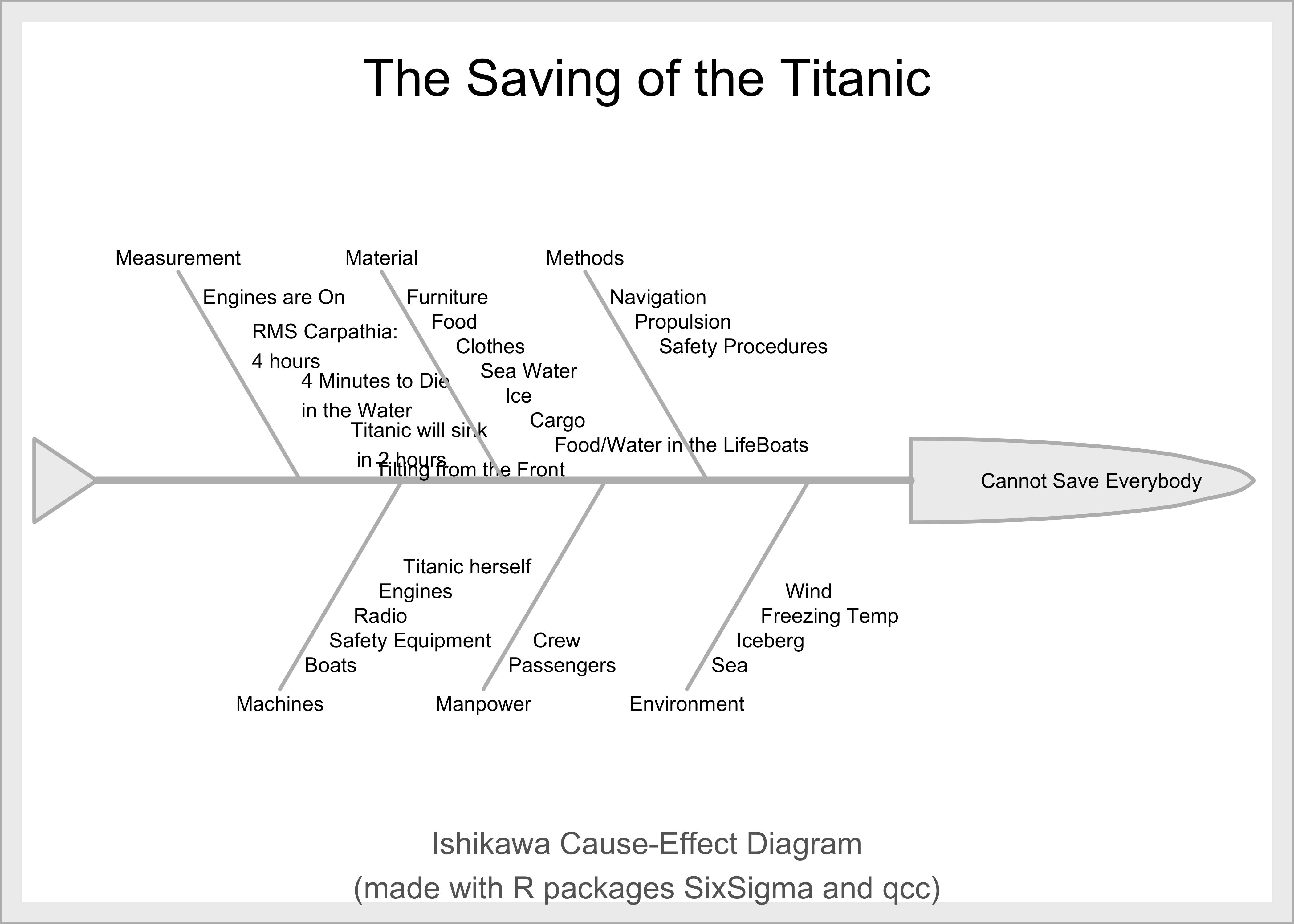
Here is the Ishikawa Diagram for this Situation:
Making an IFR for Jack and Rose
We will see immediately how this informs our World View.
How might we make Contradictions by turning the knobs on the Ishikawa? We must realize that this IFR automatically directs our choices!
ImportantIFR#1
We want to save as many people in the Boats as possible!
How might we make Contradictions?
- Boats vs People: If we try to load the Boats more heavily, more people might be saved, but the Boats might sink. If we load the Boats adequately ( as per safety norms), they will stay afloat, but not everybody can be saved.
Converting this to a TC:
-
1(Weight of Moving Object)vs31(Other Harmful Effects Generated by the System)
What Inventive Principles do we obtain?
- 35 - Parameter Change
- 30 - Flexible Shells / Thin Films
- 31 - Porous Materials
- 15 - Dynamization
How to apply these? Flexible shells? Somehow use tents? Or use Large canvas as sails for the boats? No… What materials are porous out there?
Dynamization? What, take turns sitting in the Boats and jumping out?!!!
And Parameter Change is also not very evocative…hmm, sad. Is that all we can do?
ImportantIFR#2
ALL People must be safe (for 4 hours) !!!!
Again, how might we make Contradictions?
- People vs Safety: If we use the Boats, only some People will be safe; if we fill the Boats with People, then the Boats will be un-safe!
- People vs Time/Duration: If we stay in the water, then we will be safe from the Titanic, but we might freeze to death in 4 minutes; if we stay on the Titanic, we will be safe (from freezing) but will sink with the ship (in 2 hours)
Now to make the TCs!!
- TC1:
1(Weight of Moving Object)vs38(Safety/Vulnerability) - TC2:
1(Weight of Moving Object)vs12(Duration of Action of Moving Object)
What Inventive Principles do we obtain this time?? We get:
- 8 - Anti-Weight
- 31 - Porous Materials
- 30 - Flexible Shells / Thin Films
- 13 - The Other Way Around;
- 15 - Dynamization
- 19 - Periodic Action
- 5 - Merging
8 - Anti-Weight
The Other Way Around? What is “directional” out there in the Atlantic? Our route. So? We turn the ship backwards? To where? We have only a hour so…
Anti-weight? What is an anti-weight that floats? Surely Titanic itself is not an anti-weight anymore; the Boats are of course. Anything else? Wait, the ICE!!!!
So: We reverse the engines, go back to the ICEBERG(s). And climb up that with Safety Equipment, Ropes, Mattresses, Furniture, whatever works. And the ICEBERG becomes our Anti-Weight. Only half the people need to get to on top of the icebergs; the rest can remain in the Boats. So, maybe a stretch, but Dynamization also works.
There, now do we believe, peasants?
More Case Studies for the IFR
Lawnmowers and Grass
(The following content has been taken from Ellen Domb’s article in the TRIZ Journal, Feb 1997)
Consider the power lawnmower as a tool, and the lawn as the object to be cut. The lawnmower is noisy, uses fuel, requires human time and energy, produces air pollution, throws out debris that can endanger children or pets (or the legs of the person pushing it), and is difficult to maintain. If our job is “improve the lawnmower” we could immediately set up and prioritize solutions for a number of TRIZ problems to improve fuel usage, reduce noise, improve safety, etc.
Can you still benefit from defining the IFR? Yes!
NoteIFR Direction#1
If your assignment is to reduce the noise, what is the IFR? It is a quiet lawnmower. What is the difference between “less noisy” and “quiet?”
- To reduce noise, most engineers add baffling, add dampers, muffle the noise, or in other ways add parts, thereby adding complexity and reducing reliability.
- To make the lawnmower quiet, the designer has to look at the sources of noise, and remove them. This will make the lawnmower more efficient as well as achieving the original objective of less noise, since noisy engines are inefficient, noise from vibration wastes energy, etc.
NoteIFR Direction#2
We can also define the Ideal Final Result, using a better perspective on the future of the lawnmower, and the lawn care industry. What does the customer want? The customer wants nice looking grass with no problems. The machine itself is not part of the desired solution. It should come as no surprise to find out that at least 2 companies that make lawnmowers are experimenting with “smart grass seed”–grass that is genetically engineered to grow to an attractive length, then stop growing.
The IFR is a psychological tool that orients you to the use of the technical tools. Formulating the IFR helps you look at the constraints of the problem, and consider which constraints are required by the laws of nature, and which are self-imposed (but we’ve always done it that way!) You may choose to accept the constraints in solving your problem, but at least you are then conscious of the choices. For example, in the “quiet lawnmower” case, we can choose to continue using metal cutting blades, accepting the maintenance and safety problems, but we replace the gasoline engine with an electric motor to eliminate the most significant source of noise.
TRIZ Challenge#1 Revisited (July 2001)
You hear a car (automobile) alarm go off in the car park at work. There are hundreds of cars there, in the past it has never been your car – it might be this time. Nobody else seems to respond to these alarms, they are always going off. The noise is annoying. Last time you went to look you could not see a problem. Last week one car was broken into. Nobody is responding to the alarm – should I go and look? …. But I have work to do.
- How do you make an owner aware that it is their car alarm?
- How do you design the alarm such that someone is likely to respond?
- Can you discriminate between the type of problem?
- Can the alarm be used to help catch the thief?
NoteIFR Direction#1
Yes, the alarms should sound, but they should not disturb everybody. The car alarm should be audible only to the owner of the car.
NoteIFR Direction#2
We don’t really care about the alarms at all. We care about the cars. We want cars to be safe, and alarms to be quiet.
TRIZ Challenge#2 Revisited (May 2001)
We all know the problem of speeding drivers, they go too fast down our street. There is never a speed trap there when you need it! We all like the freedom that our cars give us, it is nice to drive (fast) down the freeway with the top down. It is not always sensible, nor safe for us or others if we do this – but if it is safe to do so, then why not?
- How would you persuade drivers to keep to a sensible speed, whilst not impeding their progress when driving within the legal limits?
- How do we decide what is a sensible speed and at what level the legal limit should be set at?
- Is your answer the same if you are the only person driving on the road, compared with children walking to school in the morning?
- Given that one day we will run out of fossil fuels, does this influence your choice of maximum speed?
- Can we travel without our car, but still experience the same freedom to travel when we want to?
- Can we drive as fast as we want, whilst respecting other road users, surrounding properties, pedestrians, cyclists, and the environment?
The last question above is almost an IFR!! Let us attempt to answer the first three Questions with an IFR.
NoteIFR Direction#1
- The speed breaker should not work if you are below the speed limit. The Speed Breaker should be designed to work only when the car is above a certain speed.
- If I am the only user of the road, then children should be able to use the road at the same time as me.
NoteIFR Direction#2
My vehicle should not be affected by other vehicles or pedestrians and vice versa.
TRIZ Challenge#3 Revisited
How can you make a pump to draw water from a well or river in a developing country (such as Uganda) for next to no cost using local materials? By solving the access to water problem, people are not forced to drink dirty polluted water and because they can draw water for irrigation there is food to feed the family (and maybe some extra to sell). Gasoline powered pumps are out of the financial reach of subsistence farmers, never mind the continued cost of the fuel to run them. Electric pumps are cheaper but again if power is available the farmer cannot afford it. Then there would be the need to keep it secure.
In places like Kenya, the water table lies below the reach of simple pumps being around 20 feet below the surface. The challenge is to design a pump that can be built from materials obtained in the developing world that can pump up to 60 feet head of water and can be easily operated by either: available resource such as wind; 50 Kg (110lb) human possibly wearing a long skirt; a domestic animal. It should be capable of a flow rate of around 0.42 litres (US quarts) per second to irrigate an acre a day. The pump needs to be easily transportable, so if bought in the local market can be transported home by a mini-bus or jeep containing over 30 people.
NoteIFR Direction#1
The pump should go down into the well and fetch the water up.
NoteIFR Direction#2
The water should come up to the surface on its own.
TRIZ Challenge#4 Revisited
How do you dispose of cleaning fluids without either spreading bio-cultures or killing beneficial cultures? Within the environmental health community, it is now recognised that active bacteria in a drainage system are crucial in keeping pipes clean and free flowing. However, legislation in the medical and catering arenas insist that floors and walls should be sanitised as well as cleaned. These are usually aqueous solutions. The waste fluid will contain the debris collected during cleaning and sanitising fluid. If this is poured down the drain it will kill the bio-film and within it the beneficial bacteria. The challenge is to sanitise medical and catering facilities without killing the useful bio-flora. If liquid sanitising is used, how can the waste cleaning and sanitising fluid be disposed without affecting the environment – and can you do it cheaply? An additional challenge is to make your method work in a developing world hospital or in a bush camp. Getting this right is crucial in our battle to stop things like MRSA or ebola virus from spreading around a community such as a hospital, hotel, or school.
NoteIFR Direction#1
The solid debris is useful for drain bacteria, as food. The sanitizing fluid should clean the internal surfaces and then transport the debris to the drain bacteria and not harm them.
NoteIFR Direction#2
The operational surface must clean itself completely and not affect the bacteria in the drain
- Are drain bacteria different from indoor bacteria? ( Aerobic / Anaerobic…)
Discussion
- Did the two IFRs we created (and we can setup more if we are not happy with these!!) give use two very different views of the world where the problem has disappeared?
- Did they improve the Ideality score in different ways? How so?
- Did they seem independent of the mechanism or constraints of the original problem?
- Would you now frame the Contradictions identically or similarly in both cases?
Conclusion
- In a way, the IFR is itself an implementation of TRIZ: we are working backwards to the present from the solution, “the other way around” !! (We will see this Principle later)
- Like the Queen in Alice in Wonderland, it is important to conceptualize the Ideal Final Result as one of the six impossible things before breakfast..
- One of the ways in which this can be done is to check the implicit Assumptions that we make within a Situation, or with regard to an Object.
- Making an Assumption momentarily disappear may lead us to what Jack Hipple says in his book The Ideal Result (Reference 3)1, it’s when something performs its function, and does not exist.
- In this sense, TRIZ is a foretaste of what was said much later after TRIZ was invented, that the best Technologies are those that disappear.
Head off to Six Impossible Things before Breakfast.
References
- Ellen Domb. 1997. Using the Ideal Final Result to Define the Problem to Be Solved. The TRIZ Journal https://www.metodolog.ru/triz-journal/archives/1997/02/a/index.html
- Titanic Game (PDF)
- Darell Mann. (01)-March-2020)The Operationally Efficient Sinking of the Titanic.. TRIZ Journal. https://the-trizjournal.com/the-operationally-excellent-sinking-of-the-titanic/
- Stan Kaplan, An Introduction to TRIZ (PDF). This is a simple and short introduction to all aspects of Classical TRIZ.
- Jack Hipple, “The Ideal Result: What it is and how to achieve it”, Springer, 2012.
- Mark Weiser. The Computer for the 21st Century. Quote: The most profound technologies are those that disappear. They weave themselves into the fabric of everyday life until they are indistinguishable from it.
- Humpty Dumpty’s Recitation.
“The little fishes’ answer was
‘We cannot do it, Sir, because – ‘”.
https://www2.open.ac.uk/openlearn/poetryprescription/humpty-dumptys-recitation.html - Anne K. Halsall (2017). Six Impossible Things Before Breakfast. https://medium.com/startup-grind/six-impossible-things-before-breakfast-471848027c7f
- Abba. Believing the Impossible
Appendix
( Written after a project discussion with Aarushi Kakkar, student @ SMI, on 5th August 2024 ).
Consider the following statements: which Product or Solution might they be indicative of?
- I believe I can be in office without travelling.
- I believe that milk can boil itself and wait for me while I check my Insta.
- I believe a ball can spin in the same direction regardless of the torque applied.
- I believe elephants and monkeys who come into my orchard to raid it can decide by themselves to leave it alone.
- I believe I can remove seeds from a capsicum/bell-pepper without cutting it open.
- I believe my bike/car exhaust filter clean itself, without me scrubbing it with soap and water.
- I believe I can wear baggy, ill-fitting clothes and still look good.
- I believe that in a class/course all students taking the course must:
- have their own textbook and write it too;
- have 150% attendance;
- be able mess with time, i.e. be able slow down or speed things up on their own (like a podcast at 1.5x/0.5x) without having to leave the class. (Would you call that a “podclass”?)
- I believe it should be possible for any patient anywhere to be operated upon by a surgeon anywhere in the world.
- I believe that in a football/soccer game, each player in a team should be able to play multiple roles simultaneously.
- I believe my shirt must make itself clean after being worn for a while.
- I believe my phone must charge itself while I am not using it.
What is our immediate reaction? “It is impossible”. 2
Why do we think so? Most likely because we “know”, or rather assume that we know, how things work and these statements may make no sense at all. However, do we actually admit to those ASSUMPTIONs? How do we utter and list them? And then, how if we momentarily pretend they were impossibly not true?
Suspending the Tyranny of the Assumption, however momentarily allows us to contemplate, safely within our heads, the possibility of a Design Space that is not available…yet. It may show up things that we have been “living with” all along, without questioning why that is so. And therein, we may find an IFR.
So, with Objects and Situations, we can now do one more thing to unearth hidden problems that lie within them: look at the Assumptions that make them work. Let us list the Assumptions for some of the above statements, asserting why the statement cannot be true, but what would happen it it were! And of course, you will find yourself repeatedly asking, “What does that even mean??!!??”
The IFR: Apollo-13 once again
The IFR: We Invented the Post-It
Here is a first-person story from Art Fry and Spencer Silver, the inventors of the Post-It. Let us quickly read it to find evidence of “IFR Thinking!